
From AI Experimentation-mode to Transformative Impact 🚀

The large enterprise tech companies are stuck in what I call "AI pilot purgatory" – endless experiments that never scale beyond demo day presentations. Experimentation is certainly important for conviction but implementation → adoption will need eight legs. Here are key reasons why large enterprise technology companies may be struggling with AI adoption:
Underestimating Employee Readiness: While almost all companies invest in AI, only 1% believe they are at maturity, and the biggest barrier to scaling is often leaders who are not steering fast enough. C-suite leaders tend to underestimate how extensively their employees are already using generative AI (GenAI); for instance, they estimate only 4% of employees use GenAI for at least 30% of their daily work, whereas employees self-report this figure to be three times greater (13%)1
Lack of Bold Vision: Most organizations are not achieving the hoped-for returns on their AI investments, with only 19% reporting more than a 5% revenue increase and 36% seeing no change at all 2
Operational and Technical Challenges such as Data Quality and Integrations
Risk, Compliance and Governance
Specifically, let’s talk about why AI adoption stalls at the employee level:
• Leadership treats AI as a technical project, not a cultural shift
• Employees fear job displacement rather than job enhancement
• No clear connection between AI tools and career growth
• Lack of practical, role-specific AI training
• Bottom-up resistance when top-down mandates lack context
The ground beneath us is shifting on a daily basis and the pace at which AI-everything is evolving is too rapid to even catchup with. Products at most companies are forced to be AI-first and while those changes are being made at the technology level, there’s skill gaps across the organization to evolve and adopt AI. I am witnessing this right from the ground floor and here’s a framework I propose that I am intentionally adopting -
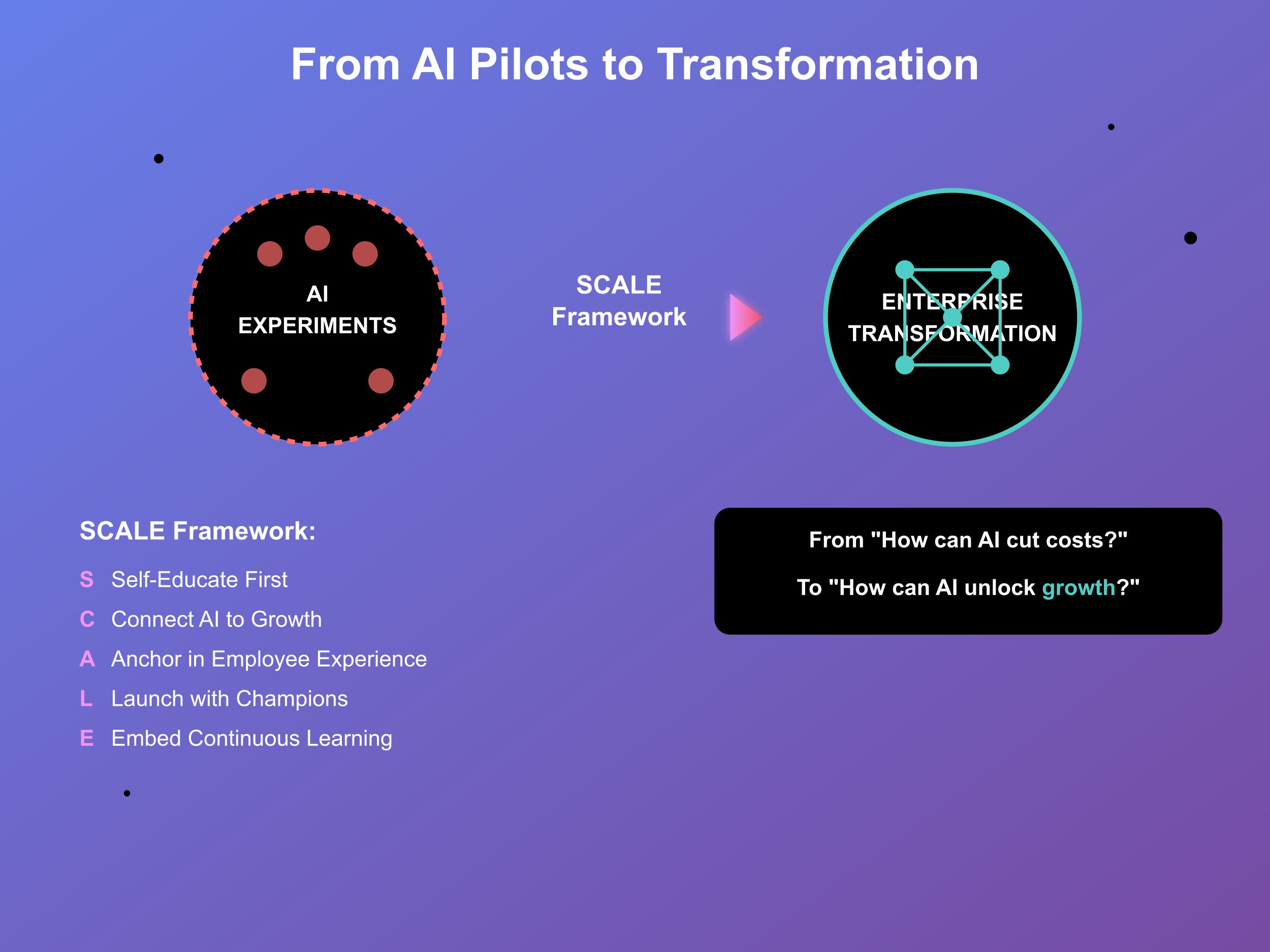
The SCALE Framework for AI Transformation:
S - Self-Educate First Leaders must become AI-fluent before expecting adoption. Spend 30 minutes daily using AI tools for your actual work. Model vulnerability – share your learning process and mistakes publicly.
C - Connect AI to Growth, Not Just Efficiency Reframe conversations from "AI will reduce headcount" to "AI will amplify human potential and thereby career growth."
A - Anchor in Employee Experience Deploy AI where it removes friction, not where it creates surveillance. Start with tools that make daily work more enjoyable – writing assistance, meeting summaries, creative brainstorming.
L - Launch with Champions Identify early adopters across departments. Give them time, resources, and recognition to become internal AI advocates. Their peer influence matters more than executive mandates.
E - Embed Continuous Learning Build AI fluency into performance goals and professional development. Create internal communities of practice. Celebrate creative AI applications and build accountability to track of adoption %s across the company.
The shift from experimentation to transformation happens when leaders stop asking "How can AI cut costs?" and start asking "How can AI unlock growth for my employees and business?"
https://www.mckinsey.com/capabilities/mckinsey-digital/our-insights/superagency-in-the-workplace-empowering-people-to-unlock-ais-full-potential-at-work
https://www.mckinsey.com/capabilities/mckinsey-digital/our-insights/superagency-in-the-workplace-empowering-people-to-unlock-ais-full-potential-at-work